

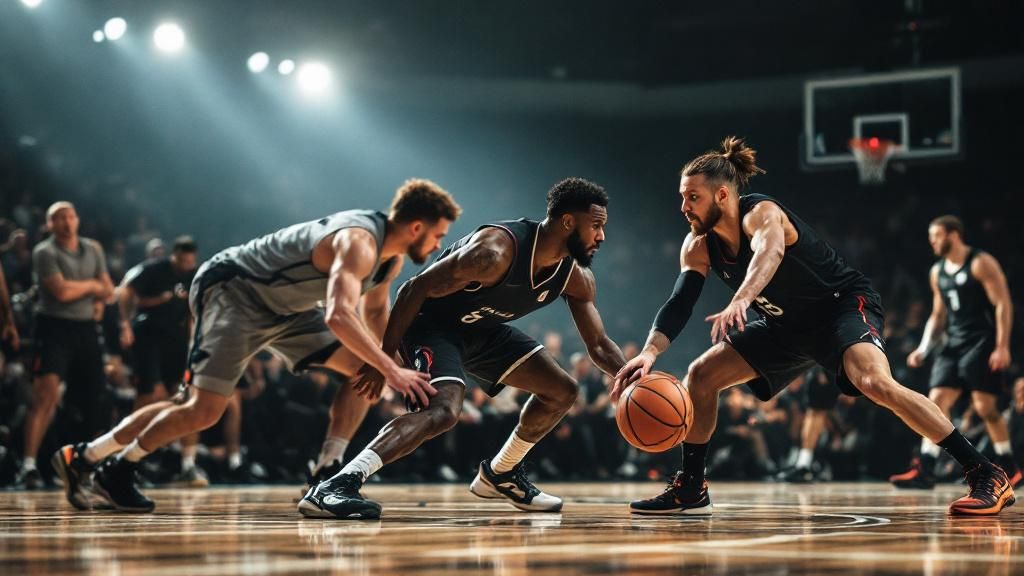
The screen and roll remains one of basketball’s most effective offensive asset, yet only the top-tier point guards fully command its sophisticated nuances. From Stephen Curry’s elite spacing to Luka Dončić’s resourceful finishing, the world’s best orchestrate this core play with exceptional sophistication. This article explores the advanced techniques that distinguish elite orchestrators from the rest, assessing how world-class creators exploit defensive schemes, create scoring opportunities, and preserve competitive advantage through polished pick and roll implementation at the top tier.
Understanding the Fundamentals of Pick and Roll Proficiency
The pick and roll constitutes basketball’s most fundamental yet profoundly effective offensive action, acting as the bedrock of modern play-calling at the highest levels. Perfecting this partnership play requires sophisticated comprehension of spacing, tempo, and defensive recognition. Leading playmakers comprehend that successful execution surpasses mere mechanical repetition; it calls for sophisticated reading of defensive alignment and split-second decision-making. The best practitioners utilise the pick and roll not merely as a means of scoring, but as a flexible instrument for generating advantages that flow through entire offensive systems, producing further openings for fellow players and prompting defensive adjustments that uncover defensive gaps.
Championship-calibre point guards set themselves apart through their ability to manipulate pick and roll variables with remarkable precision and creativity. They understand that screen angles, roll timing, and decision-making speed fundamentally determine outcomes against sophisticated defensive schemes. Understanding defensive coverages—whether switching, hedging, or blitzing—allows top-tier facilitators to predict how opponents will respond and exploit gaps accordingly. The basis of success lies in recognising that the pick and roll’s genuine strength emerges from combining technical proficiency with basketball intelligence, enabling point guards to direct offensive play with command and regularly produce high-quality scoring chances that maintain a winning edge throughout demanding seasons.
Optimising Layout and Placement Approaches
Elite point guards grasp that spacing and positioning create the basis of efficient pick and roll execution. By preserving optimal distance from teammates and the ball handler, guards open up passing lanes that defences cannot adequately cover. The most skilled playmakers position themselves to take advantage of defensive gaps, forcing defenders into uncomfortable rotations. This tactical understanding allows them to interpret defensive movements milliseconds faster than their opponents, enabling precise decision-making that separates elite performers from competent players in high-pressure competitive environments.
Positioning goes beyond mere floor spacing; it includes predicting defender reactions and adjusting accordingly. Top-tier point guards regularly assess spatial positioning, recognising how their court position affects teammate availability and scoring opportunities. By executing precise positioning and keeping track of all five defenders, elite guards control court spacing to generate beneficial assignments. This advanced strategy to positioning elevates the pick and roll from basic offensive play into a dynamic weapon, allowing squads to regularly produce quality offensive looks against even the most formidable defensive units.
Advanced Decision-Making and Reading Defences
Elite point guards demonstrate exceptional ability to read defences during pick and roll execution. These playmakers instantaneously identify whether defenders use switching, blitzing, or defensive adjustments, then exploit vulnerabilities with pinpoint accuracy. By analysing defensive tendencies beforehand and processing live adjustments, championship-calibre ball handlers regularly find available teammates or generate favourable scoring opportunities. This mental processing occurs in milliseconds, transforming the pick and roll into a tactical battle where superior intelligence prevails over opposing schemes.
The most skilled point guards create complex analytical systems for decision-making within pick and roll scenarios. Rather than predetermined actions, they leverage fine-grained situational indicators—how defenders are positioned, teammate spacing, and help rotation timing—to establish best results. Recognising when to push pace, when to hit the roller, or when to reset and initiate secondary actions separates exceptional decision-makers from competent ones. This flexibility troubles opposing defences, as their schemes grow stale against genuinely elite decision-makers who continually adapt their responses.
Mastering complex pick and roll techniques ultimately requires developing basketball’s premier intellectual requirement: reading defences with instinctive accuracy. Championship point guards transform millisecond observations into championship-winning plays through dedicated training, film study, and game-level exposure. This fusion of skill mastery, bodily prowess, and intellectual edge establishes championship calibre, enabling floor operators to consistently outmanoeuvre opponents and generate continuous winning results at basketball’s highest echelons.
